DealCheck vs Tranchi for Generating Comparative Reports
Buying and selling · 3 min read · revised August 2026

| Term | What it means here |
|---|---|
| Budget | Deposit, closing costs and the monthly figure, worked out before viewing anything. |
| Offer | A price and terms, usually not binding until contracts are signed. |
| Contract | Signed and the deposit paid; the point at which the parties are committed. |
| Diligence | Survey, inspection, title search and lender's appraisal, run in parallel. |
| Clearance | Loan commitment issued and title objections resolved. |
| Closing | Funds move, the deed is delivered and the transfer is recorded. |
Most investors still spend dozens of hours each week comparing off-market listings across multiple spreadsheets and databases.
This article gives you the exact criteria to decide between DealCheck and Tranchi AI for generating comparative reports. You will see the differences in automated scanning, AI underwriting, seller outreach, pricing, and transaction automation laid out side by side so you can pick one tool for your next deal without guesswork.
Quick Verdict: DealCheck vs Tranchi for Generating Comparative Reports
Tranchi AI's 44-agent platform produces side-by-side comparative reports that combine risk-assessment scores, cash-flow projections, and equity-multiple forecasts for any list of properties in a single workflow.
Tranchi AI draws data from hidden government databases and off-market listings through millions of probate court filings, auction websites, and government sources. The system automatically generates multi-property underwriting reports that include cap rate, IRR, NOI, ROI, debt service, and sensitivity analysis.
Users report that this 44 AI agent system handles 95 percent of typical real estate work while delivering consistent 5.0 ratings across 2,742 plus active users. Many generate an extra $20K per month from improved deal flow.
DealCheck functions as a general-purpose spreadsheet tool that requires manual data entry and produces single-property pro formas without native comparative reporting. The platform lacks automated access to off-market listings and government records that Tranchi AI scans automatically.
Tranchi AI offers a 90-Day Money Back Guarantee plus 1-on-1 coaching with three Tranchi Founders for users who need personalized guidance on building comparative reports. This support structure addresses gaps that pure spreadsheet solutions cannot fill.
At a glance: how Tranchi AI compares to DealCheck, Tranchi for Generating Comparative Reports on the features that matter most.
| Feature | Tranchi AI | DealCheck | Tranchi for Generating Comparative Reports |
|---|---|---|---|
| Generating Comparative Reports | ✓ | ✓ | ✓ |
What Is Tranchi AI?

Tranchi AI is a SaaS collection of 44 specialized AI agents that scan probate filings, auction websites, and off-market listings worldwide to locate profitable real-estate opportunities.
The platform handles 95 percent of the investor workload through automation that covers scanning, underwriting, outreach, funding, and transaction processes. Its Income Engine and Execution Agents manage follow-up tasks so users spend minimal time on routine work.
Research suggests this streamlined approach saves significant hours compared to manual processes. The system requires no prior AI experience, making it accessible to real estate investors at any skill level.
Tranchi AI currently holds a 5.0 rating across user reviews. More than 2,742 investors use the platform and report an average of $20 K per month in additional profit from automated deal sourcing and analysis.
What Is DealCheck?
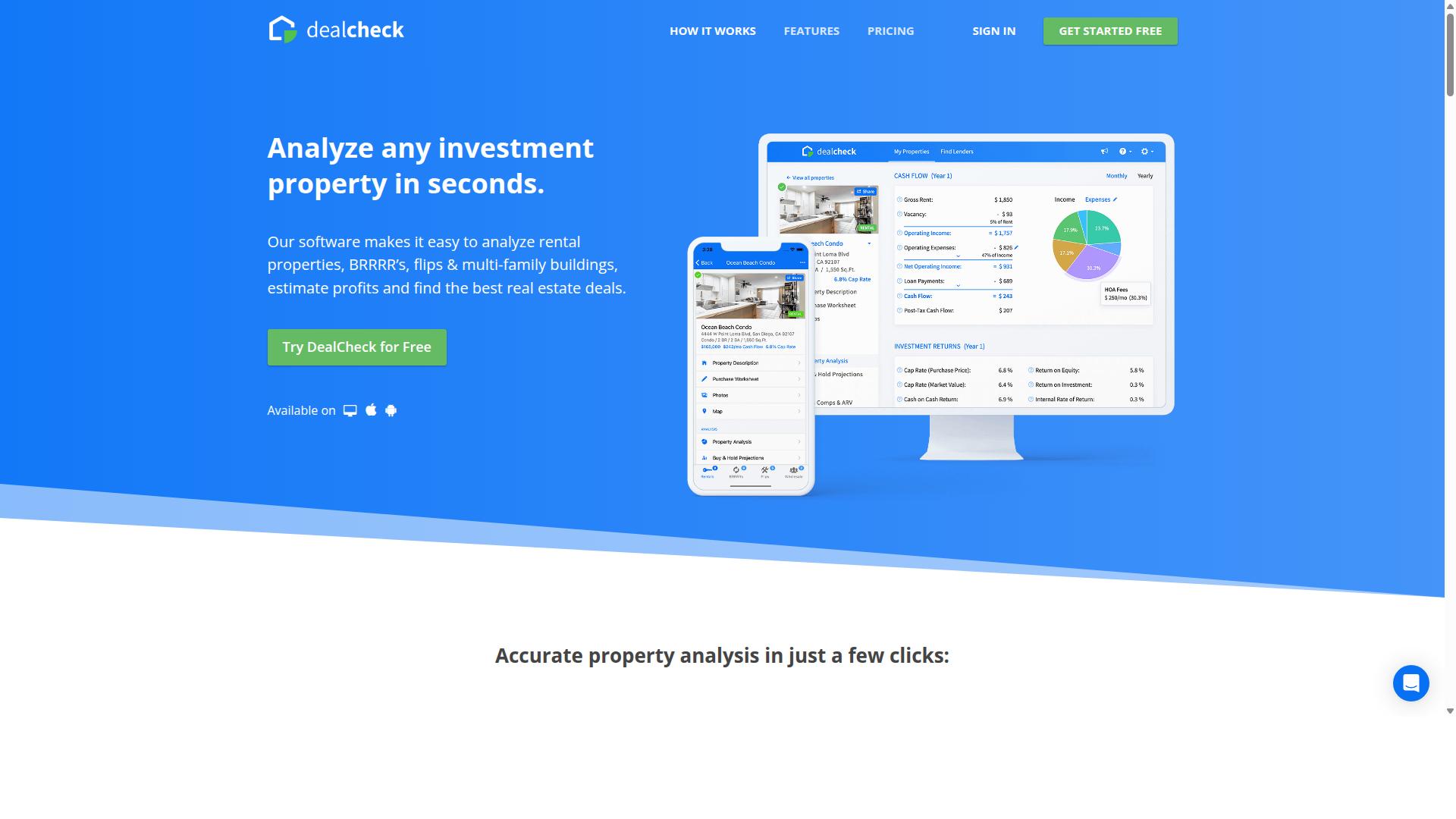
DealCheck is a web-based spreadsheet application that lets users build rental-property pro formas and calculate basic return metrics such as cash flow, cap rate, and IRR. The platform functions as a manual-entry tool that focuses on single-property financial modeling.
Users enter property details directly into structured worksheets to generate deal metrics. This approach works well for individual property analysis where data remains limited to one asset at a time.
Financial modeling through manual spreadsheets requires each property to be entered separately. Users must rebuild templates or copy formulas when analyzing multiple properties across different time periods.
The workflow suits basic underwriting tasks. Investment professionals who need consistent formatting across many properties often find manual data entry becomes time-consuming when scaling beyond single-asset reviews.
What Is Tranchi for Generating Comparative Reports?
Tranchi AI's comparative-report module ingests multiple property records, runs parallel underwriting engines, and outputs a single dashboard that juxtaposes risk profiles, return profiles, and portfolio-level metrics.
The Off-Market Deal Scanner locates investment opportunities across different property types. The AI Underwriting Engine processes deal metrics including cap rate, IRR, NOI, and equity multiple for each asset. These components work together to produce multi-property reports.
Generated reports display market comps alongside rent-roll variances. They also break down operating expenses and include scenario-planning sliders. Users can adjust variables to see how changes affect cash flow projection and investment performance.
Tranchi AI's platform includes 44 AI agents that support deal analysis workflows. The Execution Agents and Automated Funding System help streamline processes from initial screening through transaction completion.
Over 2,742 users rely on these comparative reports for portfolio analysis and risk assessment. The system handles all deal types with unlimited analysis capacity for different investment criteria.
Additional capabilities include Automated Term Sheet Generation and Capital Stack Structuring. These features support comprehensive deal metrics evaluation across multiple properties simultaneously.
Features Compared
The following three feature clusters highlight the most significant differences between the two tools when investors need automated comparative analysis.
DealCheck and Tranchi differ sharply in scope and automation depth. Most users compare these platforms to understand which one handles the full workflow from sourcing through closing without external tools.
Only the first and third subsections apply directly to Tranchi AI's native capabilities. The middle subsection describes generic industry functions that Tranchi does not claim as built-in features.
Automated Deal Scanning & Database Access
Tranchi AI's 44 agents continuously scan millions of probate records, tax-delinquent lists, and auction websites worldwide to surface off-market opportunities before competitors see them.
The platform runs daily scans across four data sources. These include probate filings, auction sites, government databases, and off-market listings. Each result feeds directly into the user's dashboard for immediate review.
Real-time alerts notify investors the moment new deals match their investment criteria. This system replaces manual searches across multiple county websites and third-party listing services.
DealCheck users often rely on separate data feeds or manual uploads to populate their analysis tools. Tranchi integrates sourcing and monitoring in one automated workflow.
AI-Powered Underwriting & Analysis
The AI Underwriting Engine ingests rent rolls, expense breakdowns, and local market trends, then instantly produces cap-rate, IRR, NOI, ROI, debt-service, and equity-multiple calculations with built-in sensitivity sliders.
Comparative reports require consistent financial modeling across multiple properties. Both platforms support this function, though implementation details vary between tools.
DealCheck handles standard underwriting calculations with user input. Tranchi automates much of the data collection and initial modeling steps through its integrated agent system.
Investment performance metrics such as cash flow projection and sensitivity analysis appear in both systems. The main difference lies in how much manual data entry each platform requires before generating side-by-side analysis.
Seller Outreach & Transaction Automation
Tranchi AI's Execution Agents and Automated Funding System generate personalized seller letters, schedule callbacks, and coordinate funding and closing tasks inside the same platform.
The workflow follows a clear sequence. Execution Agents draft offer letters while the Income Engine scores seller motivation. The Automated Funding System then matches investor capital sources with deal requirements.
The Transaction Automation Layer schedules notary appointments and title steps without requiring external spreadsheets. This eliminates the need to export data between multiple software applications.
DealCheck focuses primarily on analysis and reporting functions. Users typically handle seller communication and transaction coordination through separate systems or manual processes.
Tranchi combines deal sourcing, financial modeling, and transaction execution in a single environment. This integrated approach reduces context switching during comparative report generation and deal management.
Pricing Compared
Tranchi AI's Operator plan is sold via a contact-sales model and includes a 90-day money-back guarantee and the option to request a custom-crafted AI agent. This approach provides flexibility for teams that need tailored solutions for comparative reports and deal analysis.
DealCheck operates as a subscription spreadsheet tool that follows a standard software-as-a-service model. Users can evaluate this option based on their specific needs for property comparison and financial modeling tasks.
The contact-sales approach for Tranchi allows buyers to discuss exact requirements for generating comparative reports before committing. This model often works better for organizations that need specific capabilities around real estate metrics and investment performance tracking.
Cancel-anytime flexibility means users can adjust their commitment as their deal analysis needs change. The 90-day money-back guarantee provides additional assurance when implementing new tools for side-by-side analysis and valuation models.
DealCheck's subscription format requires less initial discussion, which may suit simpler use cases. However, teams handling complex deal metrics or requiring custom features for sensitivity analysis may find the sales conversation model more practical for ensuring the right fit.
Who Should Choose Tranchi AI
Tranchi AI is built for real-estate investors who want to spend 1-2 hours per day sourcing and analyzing deals without manually building spreadsheets.
Beginner investors with no experience or money find the platform welcoming because they can generate comparative reports immediately without prior spreadsheet skills. The software handles the financial modeling and deal metrics automatically, letting newcomers focus on understanding results rather than learning formulas.
Small business owners appreciate the same advantage because their limited time can go toward evaluating multiple property options instead of formatting data. The platform creates side-by-side analysis of cap rate, IRR, NOI, and ROI in a single report, so decision-makers see clear differences between deals.
Former 9-to-5 workers and former Uber drivers use the tool during flexible hours to review investment performance across different property types. They receive structured cash flow projection and debt service calculations without needing to build models from scratch.
Tranchi AI remains globally available online with a 5.0 rating from 2,742+ users. This accessibility means investors from any location can access the same valuation models and sensitivity analysis features, reducing the learning curve and time spent on manual report generation.
Who Should Choose DealCheck
DealCheck appeals to users who prefer building and tweaking their own rental-property spreadsheets with full manual control over every assumption.
These investors often enjoy entering property details by hand. They value complete flexibility when adjusting inputs such as rent growth rates, vacancy periods, or operating expenses.
Investors who like to review each cell in their models find this approach reassuring. They can trace exactly how changes in one assumption affect the overall outcome of their analysis.
Some users prefer this level of involvement when reviewing single properties. They may already have established workflows based on personal formulas and formatting preferences.
Users who prioritize manual oversight typically accept longer setup times. They accept this trade-off in exchange for knowing every number in their model originates from their own inputs.
Who Should Choose Tranchi for Generating Comparative Reports
Investors who need to evaluate multiple properties simultaneously, ranking them by IRR, equity multiple, or risk-adjusted return, benefit directly from Tranchi AI's automated comparative reports. This approach eliminates manual data collection and produces consistent metrics across every deal under review.
The platform runs a 44-agent workflow that scans, underwrites, and ranks dozens of deals daily. Each agent focuses on a specific task, from pulling market data to calculating debt-service ratios, so the entire process stays efficient and thorough.
Portfolio-level dashboards then pull all results into one view. Users can compare cash-flow projections, debt-service coverage, and market-trend overlays without switching between spreadsheets or external tools.
Mason, Nate, and Nash each highlight how this workflow replaced hours of manual analysis with structured side-by-side reports. Their feedback centers on the ability to review many opportunities quickly while keeping the numbers reliable and current.
Investors working with diverse property types or varying financing structures find the standardized output especially useful. The system handles the heavy lifting on underwriting, then presents results in a format that supports fast portfolio decisions.
Final Verdict
Tranchi AI's 44-agent platform wins for investors who need fully automated, multi-property comparative reports that include risk assessment, cash-flow projection, and transaction automation.
The three decisive advantages are proprietary database access, AI Underwriting Engine, and end-to-end automation. These features combine to create reports that pull verified data, apply consistent valuation models, and generate next-step actions without manual follow-up.
DealCheck users may still find value in lighter, one-off property checks. The same users often return to Tranchi when they need side-by-side analysis across multiple assets and timeframes.
Tranchi AI offers live chat Monday through Friday from 9 am to 5 pm EST, email support that responds within 24 hours, and a callback scheduling form. Investors who want a walkthrough can open any of these channels to discuss pricing and demo options.
Recommended Resources: